
-
 Australia
-
 Austria
-
 Belgium
-
 Brazil
-
 Canada
-
 China
China
-
 Czech Republic
-
 Denmark
-
 Finland
-
 France
-
 Germany
-
 Greece
-
 Hong Kong
-
 Hungary
-
 Iceland
-
 India
India
-
 Ireland
-
 Israel
-
 Italy
Italy
-
 Japan
Japan
-
 Korea
Korea
-
 Luxembourg
-
 Malaysia
-
 Netherlands
-
 New Zealand
-
 Norway
-
 Poland
-
 Qatar
Qatar
-
 Romania
-
 Saudi Arabia
-
 Singapore
-
 Spain
Spain
-
 Sweden
-
 Switzerland
-
 Taiwan
-
 Turkey
-
 United Kingdom
-
 United States
research use only
Regorafenib Hydrochloride VEGFR inhibitor
Cat.No.S4947
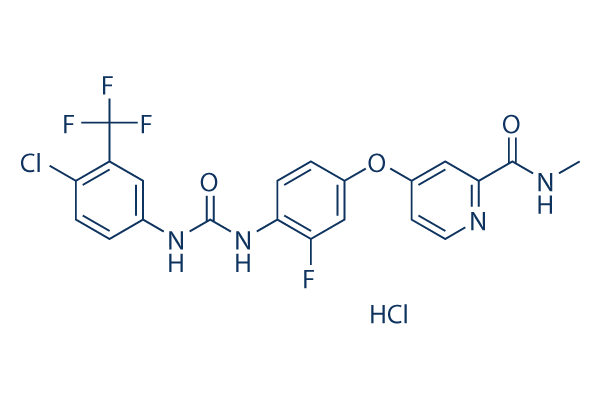
Chemical Structure
Molecular Weight: 519.28
Quality Control
| Related Targets | EGFR PDGFR FGFR c-Met Src MEK CSF-1R FLT3 HER2 c-Kit |
|---|---|
| Other VEGFR Inhibitors | SAR131675 SU 5402 Cediranib (AZD2171) Vatalanib (PTK787) 2HCl Anlotinib (AL3818) Dihydrochloride Linifanib (ABT-869) Apatinib (YN968D1) Apatinib (YN968D1) mesylate Semaxanib (SU5416) Ki8751 |
Solubility
|
In vitro |
DMSO
: 100 mg/mL
(192.57 mM)
Water : Insoluble Ethanol : Insoluble |
Molarity Calculator
|
In vivo |
|||||
In vivo Formulation Calculator (Clear solution)
Step 1: Enter information below (Recommended: An additional animal making an allowance for loss during the experiment)
Step 2: Enter the in vivo formulation (This is only the calculator, not formulation. Please contact us first if there is no in vivo formulation at the solubility Section.)
Calculation results:
Working concentration: mg/ml;
Method for preparing DMSO master liquid: mg drug pre-dissolved in μL DMSO ( Master liquid concentration mg/mL, Please contact us first if the concentration exceeds the DMSO solubility of the batch of drug. )
Method for preparing in vivo formulation: Take μL DMSO master liquid, next addμL PEG300, mix and clarify, next addμL Tween 80, mix and clarify, next add μL ddH2O, mix and clarify.
Method for preparing in vivo formulation: Take μL DMSO master liquid, next add μL Corn oil, mix and clarify.
Note: 1. Please make sure the liquid is clear before adding the next solvent.
2. Be sure to add the solvent(s) in order. You must ensure that the solution obtained, in the previous addition, is a clear solution before proceeding to add the next solvent. Physical methods such
as vortex, ultrasound or hot water bath can be used to aid dissolving.
Chemical Information, Storage & Stability
| Molecular Weight | 519.28 | Formula | C21H16Cl2F4N4O3 |
Storage (From the date of receipt) | 3 years -20°C powder |
|---|---|---|---|---|---|
| CAS No. | 835621-07-3 | -- | Storage of Stock Solutions |
|
|
| Synonyms | Stivarga, BAY 73-4506 hydrochloride | Smiles | Cl.CNC(=O)C1=NC=CC(=C1)OC2=CC(=C(NC(=O)NC3=CC(=C(Cl)C=C3)C(F)(F)F)C=C2)F | ||
Mechanism of Action
| Targets/IC50/Ki |
RET
(Cell-free assay) 1.5 nM
Raf-1
(Cell-free assay) 2.5 nM
Murine VEGFR2
(Cell-free assay) 4.2 nM
Kit
(Cell-free assay) 7 nM
VEGFR1
(Cell-free assay) 13 nM
PDGFRβ
(Cell-free assay) 22 nM
Murine VEGFR3
(Cell-free assay) 46 nM
|
|---|---|
| In vitro |
Regorafenib strongly prevents VEGFR2 autophosphorylation in NIH-3T3/VEGFR2 cells with IC50 of 3 nM. In HAoSMCs, regorafenib suppresses PDGFR-β autophosphorylation after stimulation with PDGF-BB, with an IC50 of 90 nM. Regorafenib also inhibits FGFR signaling in MCF-7 breast cancer (BC) cells stimulated with FGF10. Regorafenib very potently inhibited the mutant receptors KITK642E and RETC634W, with IC50 of approximately 20 nM and 10 nM, respectively. Regorafenib inhibits the proliferation of VEGF165-stimulated HUVECs, with an IC50 of approximately 3 nM. Regorafenib prevents the proliferation of FGF2-stimulated HUVECs and of PDGF-BB-stimulated HAoSMCs with IC50 of 127 nM and 146 nM, respectively. Regorafenib targets both tumor cell proliferation and tumor vasculature through inhibition of receptors of tyrosine kinases (VEGFR, KIT, RET, FGFR, and PDGFR) and serine/threonine kinases (Raf and p38MAPK). Regorafenib suppresses growth of human Hep3B, PLC/PRF/5 and HepG2 cells in a concentration- and time-dependent manner. |
| Kinase Assay |
Kinase assays
|
|
In vitro assays using recombinant VEGFR2 (murine aa785–aa1367), VEGFR3 (murine aa818–aa1363), PDGFRβ (aa561–aa1106), Raf-1 (aa305–aa648) and BRafV600E (aa409–aa765) kinase domains are performed. Initial in vitro kinase inhibition profiling is performed at a fixed 1 μM Regorafenib concentration. Inhibitory concentration of 50% (IC50) values are determined from selected responding kinases, e.g., VEGFR1 and RET. TIE2 kinase inhibition is measured with a homogeneous time-resolved fluorescence (HTRF) assay using a recombinant fusion protein of glutathione-S-transferase, the intracellular domain of TIE2 and the peptide biotin-Ahx-EPKDDAYPLYSDFG as substrate.
|
|
| In vivo |
Regorafenib reveals potent dose-dependent TGI in various preclinical human xenograft models in mice, with tumor shrinkages in breast MDA-MB-231 and renal 786-O carcinoma models. Regorafenib prevents not only the growth of syngeneic primary 4T1 breast tumors growing orthotopically in the fat pad, but also suppresses the formation of tumor metastasis in the lung. |
References |
|
Clinical Trial Information
(data from https://clinicaltrials.gov, updated on 2024-05-22)
| NCT Number | Recruitment | Conditions | Sponsor/Collaborators | Start Date | Phases |
|---|---|---|---|---|---|
| NCT03386825 | Completed | Colorectal Neoplasms |
Bayer |
January 31 2018 | -- |
| NCT01959269 | Completed | Colorectal Neoplasm |
Bayer |
October 31 2013 | -- |
| NCT01002378 | Completed | Dietary Fats|Pharmacokinetics |
Bayer |
October 2009 | Phase 1 |
| NCT01003015 | Completed | Carcinoma Hepatocellular |
Bayer |
September 2009 | Phase 2 |
Tech Support
Tel: +1-832-582-8158 Ext:3
If you have any other enquiries, please leave a message.
Signaling Pathway Map

Products are for research use only. Not for human use. We do not sell to patients.
©Copyright 2013 Selleck Chemicals. All Rights Reserved.